Enterprise-grade case management at a small-firm price.
SettleStack by Verodi runs every matter, deadline, document, and dollar in one system — flat monthly fee, run for you. And it's the only case system that goes out and gets your medical records itself.
Live in production on real personal-injury cases. HIPAA, signed BAAs.
SettleStack by Verodi is a managed case management and medical records system for injury-led law firms with 1–20 attorneys. It retrieves medical records, chases providers, reconciles bills against records, and runs case deadlines — done for you on a flat monthly retainer starting at $1,999/month, with no per-seat fees and no long-term lock-in. It works alongside FileVine or SmartAdvocate, or replaces the case stack when the firm is ready. Built for personal injury, medical malpractice, and workers' compensation, it also runs general matters for the rest of the practice. HIPAA-compliant, with signed BAAs.
Built for firms that live on injury cases.
The cases that pay you most run on medical records — so those cases get an engine, not a folder. And the rest of your practice doesn't get left in a different system.
Injury cases get the full records engine
Personal injury · Medical malpractice · Workers' compensation
- Records retrieved, providers chased automatically until they respond
- Every bill reconciled against the record — gaps flagged with dates
- Chronology builds itself as records land
- Liens & subrogation carried through to the disbursement sheet
SettleStack runs the rest of your practice
Business · Criminal · General matters
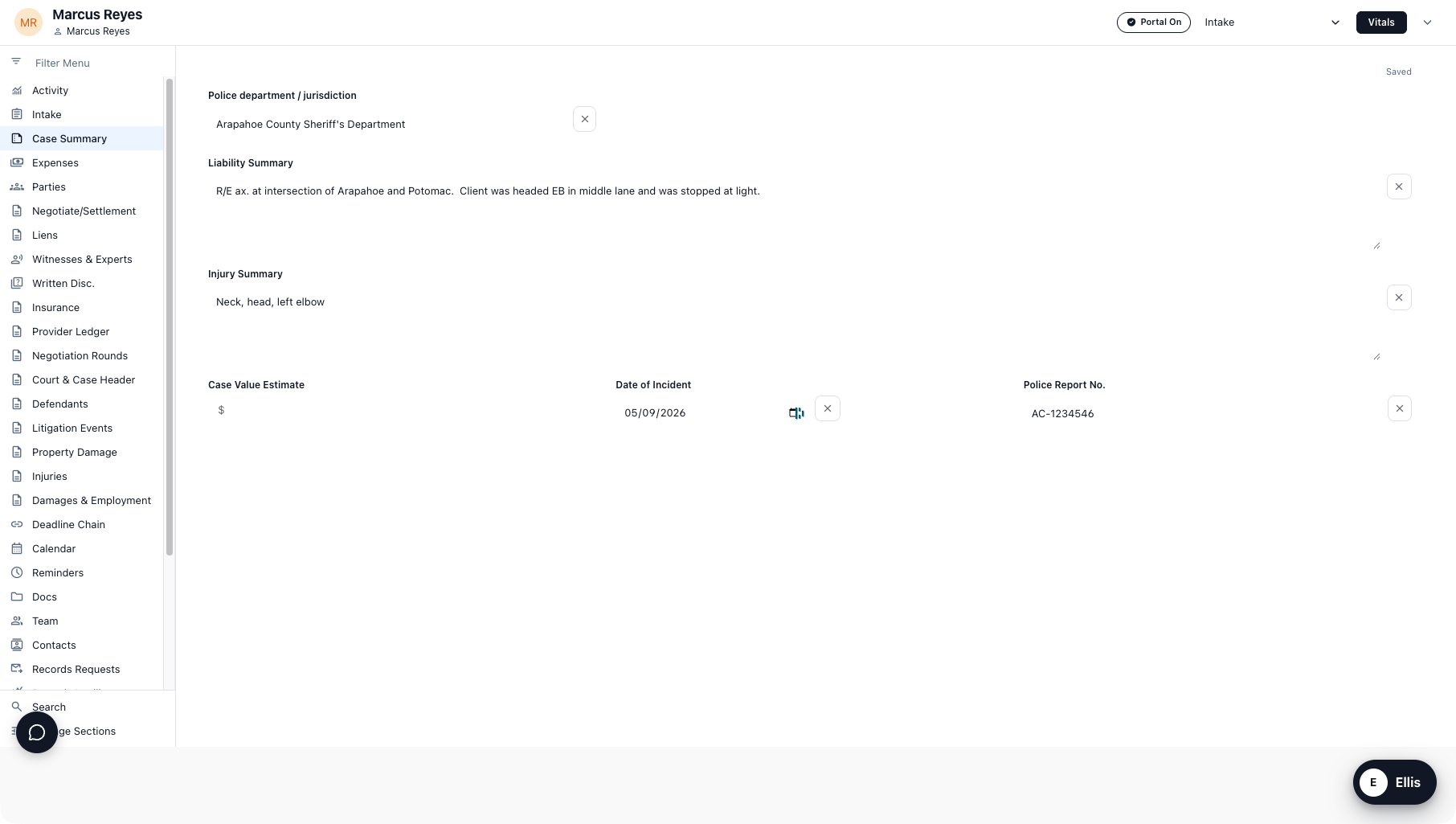
- Contacts, deadlines, documents, and notes on every matter
- Time and expenses tracked, exportable any day
- One system for the whole firm — not just the injury side
- Keep your billing tool; SettleStack replaces everything else
See it working.
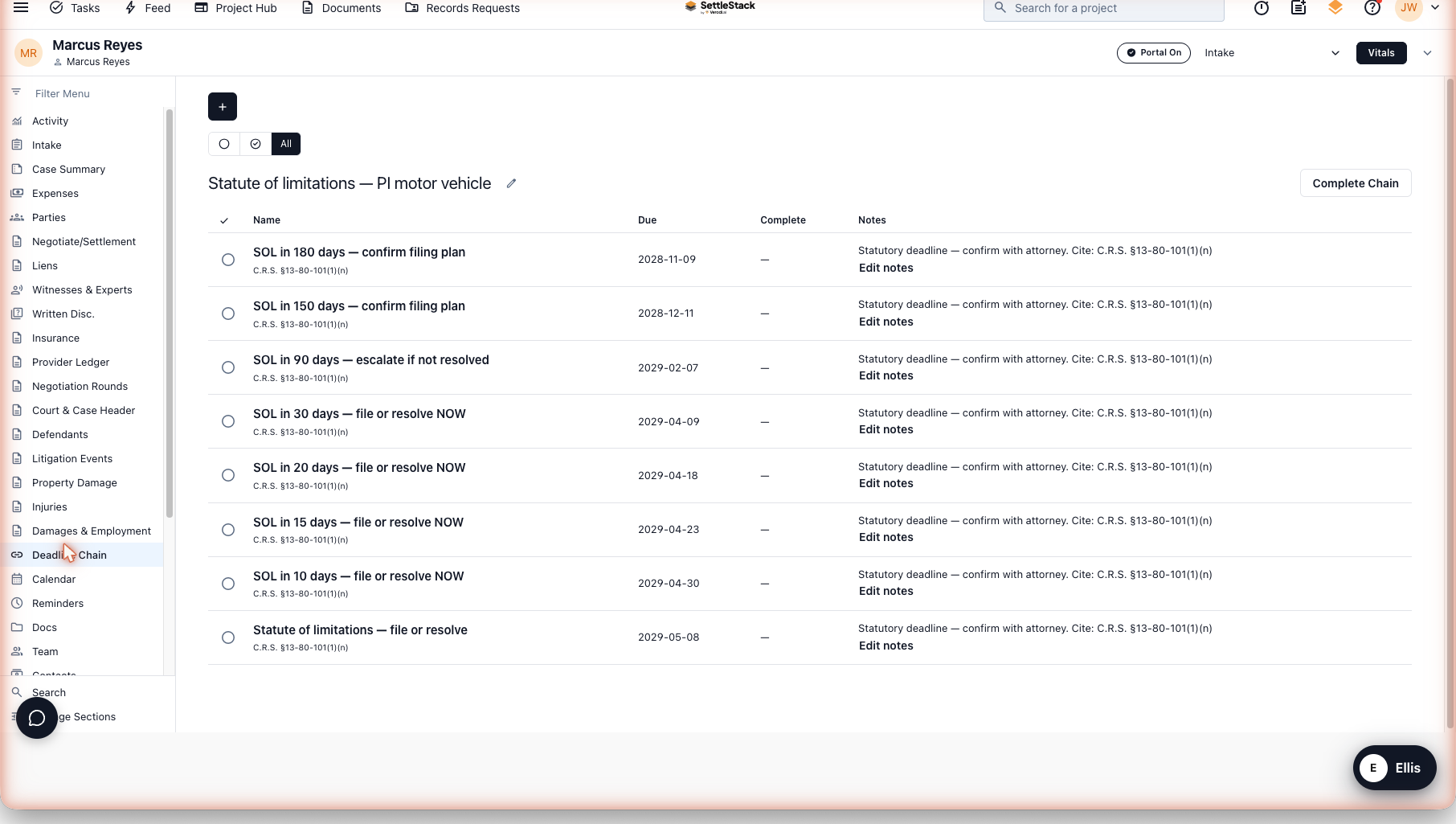
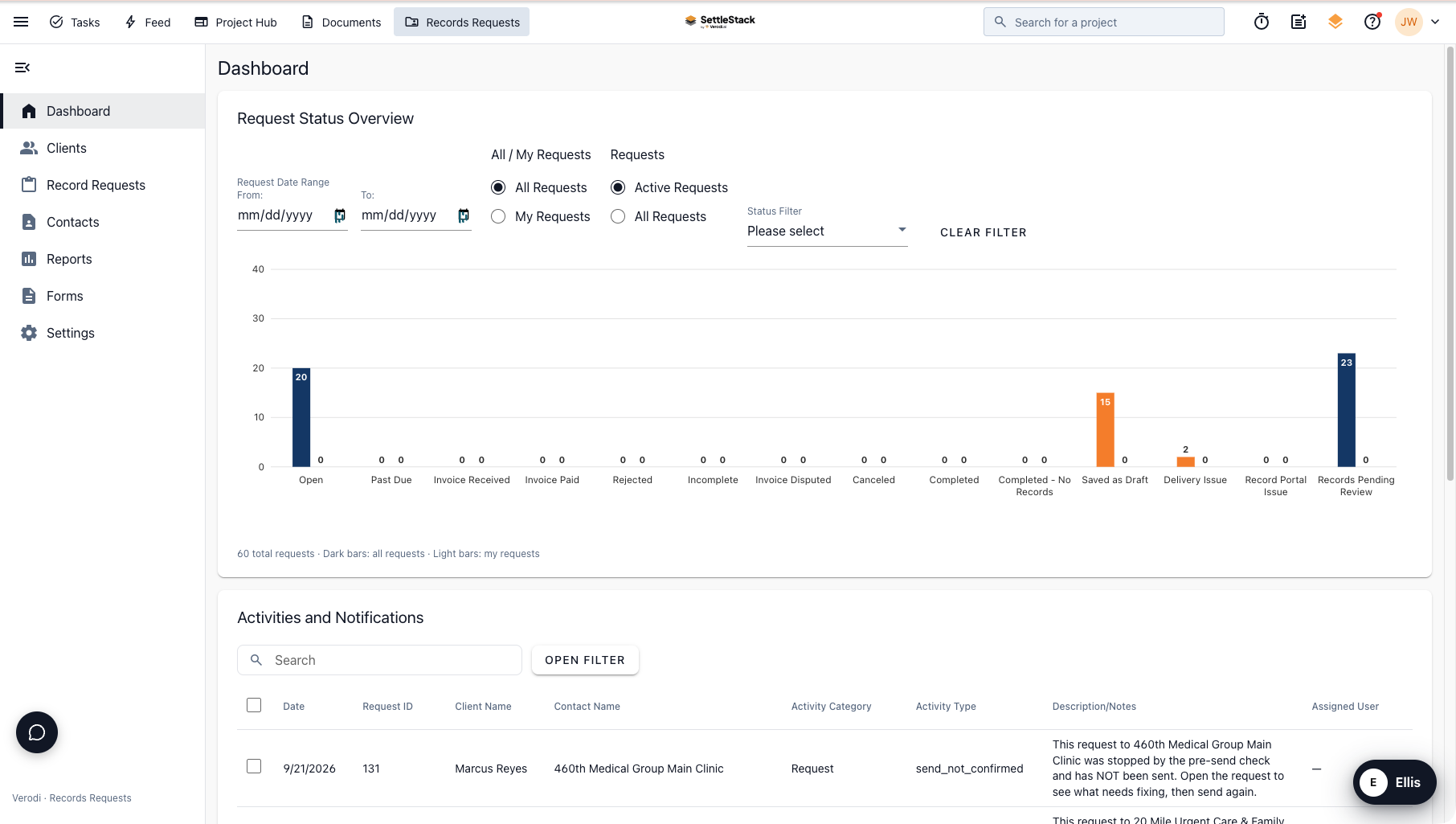
Not mockups — the live system, on demonstration data. This is what your team logs into.
Your case platform bills like a firm of forty works here.
Per-seat pricing, an AI tier, modules half the firm never opens — and the renewal lands every year whether it earned it or not. A two-attorney firm doesn't need less case management. It needs case management sized to how a two-attorney firm actually works.
What the five-figure renewal buys
- A seat charge for every hirethe price climbs every time the firm grows
- Modules built for big firmspaid for across the catalog, used in a narrow slice
- Software you operatesetup, cleanup, and upkeep land on your staff
- And it still won't get your recordsretrieval is outsourced to a vendor you also pay
What SettleStack replaces it with
- One flat monthly feeadd attorneys and staff — the price doesn't move
- Built around a small firm's daydeadlines, statute chains, documents, contacts, time, expenses
- Run for you by Verodiwe migrate you, configure it, and keep it tuned
- Every matter, not just injurybusiness, criminal, comp — the whole practice in one place
The part no case platform will do: it gets the records.
Every case system stores records somebody else fetched. SettleStack goes and gets them — requests out the way each provider wants them, follow-ups sent on schedule until the records land, every bill reconciled against every record, gaps flagged with dates before the demand goes out. Your paralegal approves what leaves; the chasing stops being their job.
A missed record is money left on the table. A complete, proven file is leverage. That check — the file proven complete — is the piece nobody else in the category has.
What each kind of tool actually does.
By category, on the jobs a small firm actually runs. The last row is a real gap — we'd rather you learn it here than in a demo.
| The job to be done | Case platform | Records vendor | Demand AI | SettleStack |
|---|---|---|---|---|
| Case file, contacts, documents, notes | ||||
| Deadlines & statute chains that recalculate | ||||
| Time & expenses on every matter | ||||
| Non-injury matters in the same system | ||||
| Flat fee — add staff, price doesn't move | varies | |||
| Goes out and gets the records | outsourced | |||
| Chases the provider until it lands | you chase | |||
| Reconciles every bill against the record | flags some | |||
| Liens & subrogation into the disbursement sheet | ||||
| Somebody runs it for you | ||||
| E-signature, client texting, court-rules calendaring |
The last row is real: we don't do e-sign or client texting today. If those are dealbreakers, we'll tell you on the call — before you've moved anything.
Two ways in.
Most firms replace the stack. Firms locked into a platform start with the records engine alone.
"We're two attorneys paying five figures for software we half-use."
Replace the stack.
SettleStack runs the whole practice — every matter, every deadline, plus the records engine on the cases that pay you. One flat retainer instead of a platform, a records vendor, and the glue hours between them.
- Statute chains that seed themselves and recalculate
- General matters for the rest of the practice — business, criminal, comp
- Flat fee: add attorneys and staff, the price doesn't move
- Verodi migrates you and runs it. Month to month, no lock-in.
"We're mid-contract on our platform. The records are what's killing us."
Keep your system — for now.
The SettleStack records engine rides alongside whatever you run today. No switch, no migration. We retrieve, chase, and reconcile; your team just sees complete files. Move the rest when your renewal comes up.
- Requests out the way each provider wants them
- Follow-ups send themselves until the record arrives
- Every bill matched to a record; every unmatched dollar surfaced
- A human approves everything that leaves the building
Built on real work. Not slideware.
In production
Live and running real cases today — real records, real bills, real deadlines.
Founder-built
Verodi didn't buy this platform or white-label it. We engineered it — and we run it.
HIPAA-grade
Signed BAAs and PHI handling built in from day one — not bolted on after.
In production today
SettleStack runs live cases for a working personal-injury firm right now. Numbers get published when they're meaningful, with the firm's permission.
Frequently asked questions.
What is SettleStack?
SettleStack by Verodi is a managed case management and medical records system for injury-led law firms with 1–20 attorneys. It retrieves medical records, chases providers, reconciles bills against records, and runs case deadlines — done for you on a flat monthly retainer starting at $1,999/month, with no per-seat fees and no long-term lock-in. It works alongside FileVine or SmartAdvocate, or replaces the case stack when the firm is ready. Built for personal injury, medical malpractice, and workers' compensation, it also runs general matters for the rest of the practice. HIPAA-compliant, with signed BAAs. It runs as a done-for-you service — not a software license your staff has to operate. Book a demo at verodi.ai/contact or email [email protected].
How is SettleStack different from a medical records retrieval company?
A retrieval company delivers whatever the provider sends and closes the ticket. SettleStack reconciles every medical bill against the records received, flags treatment that was billed but never documented, and chases the gap before the demand goes out — so the file is provably complete.
What is bill-to-record reconciliation?
Bill-to-record reconciliation checks every line-item a provider billed against the medical records actually produced. If a bill references a visit or treatment that never appears in the records, the file is incomplete — and a demand built on it leaves settlement money on the table.
Do I have to switch off FileVine to use SettleStack?
No. SettleStack's records completion work rides alongside whatever case management system your firm already uses. SettleStack is also a full case management system in its own right — and if you do choose to move, Verodi handles the migration for you.
How much does SettleStack cost?
SettleStack is priced as a flat monthly retainer with three tiers, starting at $1,999/month — no per-seat fees, no per-page retrieval charges, and no long-term contract. Add every attorney and paralegal you want at no extra cost. Exact tier pricing is sized to your firm's caseload on a short call.
Is SettleStack HIPAA compliant, and will you sign a BAA?
Yes. Verodi operates as a HIPAA Business Associate and signs a BAA with every client firm. Every vendor in SettleStack's infrastructure that touches protected health information is also covered by a signed BAA, and all data is hosted on Microsoft Azure in the United States.
How long does it take to get complete medical records on a personal injury case?
Manual records requests routinely take 30 to 90 days per provider, and firms rarely chase every gap. SettleStack sends requests the day a case opens, follows up with every provider automatically on a schedule, and reconciles what comes back — so gaps get caught and chased instead of discovered at demand time.
Does SettleStack share my firm's data with other firms?
Never. Each firm's cases, clients, and documents live in their own isolated tenant and are never shared. The only thing Verodi learns across firms is provider contact logistics — which fax lines work and how fast providers respond — never any case or client information.
What size law firm is SettleStack built for?
SettleStack is built for injury-led firms with roughly one to twenty attorneys — firms large enough to drown in records requests but too small to staff a records department. The flat retainer replaces a records vendor, spare software seats, and the manual hours between them.
What case types does SettleStack handle?
Personal injury, medical malpractice, and workers' compensation cases get the full records engine — retrieval, chase, and bill-to-record reconciliation. General matters carry the rest of your practice — business, criminal, and other case types — with contacts, deadlines, documents, notes, time, and expenses in the same system.
Do the math before the renewal does.
Bring your current software bill to one call. If one flat fee doesn't beat the platform, the records vendor, and the staff hours between them, we'll tell you to stay put. One business-day reply.
- Lower software costs in your first month of engagement
- No switching your case system to see it work
- Talk directly to the people who built it — not a sales rep
- Month to month. Walk any month we're not earning it.